HPE 875056-001 Proliant Secondary Riser Cage DL3XX GEN10 M.2 Primary/secondary
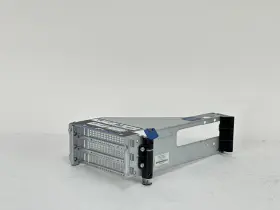
( Brand: Hpe ), ( Manufacturer Part Number: 875056-001 ), ( Country/region Of Manufacture: China ), ( Product Line: Proliant Dl )
Review HPE Proliant Dl3x M.2 Primary/secondary Riser Cage
The 875056-001 ProLiant DL380p Gen10 M.2 Primary/Secondary Riser Cage is an essential component for expanding the storage capabilities of Hewlett Packard Enterprise's ProLiant DL380p Gen10 server. This M.2 riser cage provides an additional two M.2 slots for solid-state drives (SSDs), enabling users to install more high-speed, low-latency storage devices in their server. These slots are designed to accommodate both 2280 and 22110 form factor M.2 SSDs, making it a versatile option for various SSD sizes.
Constructed from robust materials and featuring a sleek, streamlined design, the M.2 Primary/Secondary Riser Cage provides reliable performance and enhanced data security. The cage is designed to fit seamlessly into the ProLiant DL380p Gen10 server chassis and securely holds the M.2 SSDs in place using screws, ensuring that the drives are stable and secure during operation.
The cage also offers flexible configuration options for primary and secondary M.2 slots. The primary slot supports four-lane NVMe devices, providing better performance for data-intensive workloads, while the secondary slot supports two-lane NVMe devices or SATA M.2 SSDs. This flexibility allows users to optimize their storage configurations according to their specific applications and performance requirements.
The M.2 Primary/Secondary Riser Cage also features built-in thermal management to maintain the optimal operating temperature of the M.2 SSDs. The cage efficiently dissipates heat through its innovative design, ensuring the reliable performance of the storage devices and reducing the risk of thermal throttling.
Installation of the M.2 Primary/Secondary Riser Cage in the ProLiant DL380p Gen10 server is straightforward and can be completed with minimal downtime. The cage comes with all necessary screws, making the installation process quick and easy. Additionally, the riser cage is designed for tool-less installation of the M.2 SSDs using the provided clips, allowing for easy upgrades and hot-swapping of the drives when needed.
In conclusion, the 875056-001 ProLiant DL380p Gen10 M.2 Primary/Secondary Riser Cage is an essential add-on component for users looking to expand their ProLiant DL380p Gen10 server's storage capabilities. Its robust design, flexible configuration options, and efficient thermal management make it a reliable and versatile solution for enhancing storage performance in data-intensive environments.
The Proliant DL3xx Gen10 M.2 primary/secondary riser cage (model number 875056-001) is a component designed for adding M.2 solid-state drives (SSDs) to Hewlett Packard Enterprise's (HPE) Proliant DL3xx series Gen10 servers. This accessory expands the server's storage capacity, enabling the use of high-performance M.2 SSDs. In this analysis, we will discuss the pros and cons of purchasing a 875056-001 M.2 riser cage for your Gen10 Proliant DL3xx server, followed by a conclusion and a recommendation.
Pros:1. Increased Performance: The use of M.2 SSDs with the riser cage can deliver faster read and write speeds compared to traditional 3.5-inch SAS or SATA drives. This leads to improved application performance, quicker boot times, and an overall better server experience.
2. Higher Density: The M.2 format is smaller than traditional SAS or SATA drives, allowing for a higher number of drives to be installed in the same amount of space. In a server environment where capacity and performance are vital, the increased density can be a significant advantage.
3. Flexibility: TheDesign of the riser cage allows users to install primary or secondary M.2 drives, providing flexibility in how the storage is configured.
4. Compatibility: Being an official HPE accessory, the 875056-001 M.2 riser cage is guaranteed to be compatible with the Gen10 Proliant DL3xx server series. This ensures a seamless integration with your existing infrastructure.
Cons:1. Cost: M.2 SSDs and the riser cage itself are often more expensive compared to traditional SAS or SATA drives. Therefore, purchasing this accessory can result in a higher initial investment.
2. Complexity: Installing M.2 drives with the riser cage may require additional cabling and tools compared to using regular 3.5-inch drives. Additionally, the server must support M.2 drives and have available M.2 slot(s).
3. Limited Capacity: M.2 drives still come with varying capacities, though they typically offer lower capacities compared to their 3.5-inch counterparts. This might necessitate the need to purchase multiple M.2 drives to meet the desired capacity if using only this form factor.
Conclusion:The HPE Proliant DL3xx Gen10 M.2 primary/secondary riser cage (model number 875056-001) provides several advantages for server users in terms of performance, density, flexibility, and compatibility. However, these benefits also come with a higher cost and added complexity. Ultimately, the decision to purchase this riser cage depends on individual requirements and priorities. If improved storage performance and flexibility, along with the ability to accommodate higher drive densities, justify the investment, then the riser cage can be a valuable addition to your Gen10 Proliant DL3xx server. However, if budget or server capacity requirements are a significant concern, other storage solutions should be considered.
Recommendation: To make an informed decision, first, analyze your specific use case and server environment by assessing the critical factors below:1. Total storage capacity required
2. Available budget
3. System compatibility (server type, expansion slots, and supported drive sizes)
4. Performance requirements
5. The desire for higher density.
It is essential to consider these factors carefully to determine if the Proliant DL3xx Gen10 M.2 primary/secondary riser cage is the best fit for your needs. If your infrastructure aligns with the advantages the riser cage offers, then it can be a wise investment to enhance your Gen10 Proliant DL3xx server's capabilities. If not, alternative storage solutions may be more appropriate.
Details:
part #: 875056001 prices
- $39.99-$179.00
specifications servertimber:
- brand: Hpe
- mpn: 875056-001
- country/region of manufacture: China
- product line: Proliant Dl
offer servertimber:
- best offers: True
- availability: In Stock
- started: January 20, 2025
- options: Ship-to-home
- sold: 0
- quantity: 1
general servertimber:
- condition: Open box
- Enterprise Networking, Servers > Server Components > Server Boards
seller servertimber:
- # reviews: 3013
- rating: 97.9%
- city: Albany, New York
shipping servertimber:
- service: FedEx Ground or FedEx Home Delivery, UPS 3 Day Select, UPS 2nd Day Air, UPS Next Day Air Saver
- transit: 3-7 Days
- carrier: FedEx, UPS
- cost: $0.00
- type: Calculated
- class: Standard, Expedited, One-day
returns servertimber:
- time: 30 Days
- paid by: Seller
- policy: Returns Accepted
- method: Money back
payments servertimber:
- credit card: Diners-club
- wallet: Apple-pay
- other
Hpe 875056-001 Is Similar To:
- Hp 878926-001 Hpe For Proliant Ml110 G10 874022-001 8 Dimms System Board (42.9% similar) This unit does not come with any cables, accessories, disks, or instructional booklet's. This unit was previously used and may show some signs of wear. Testing procedures. Model: 878926-001. Type: system board. After installation of the windows operating system, each computer is...(May 23rd, 2024)
- Hp 875073-001 Hpe 809455-001 Proliant Dl380 G10 Gen10 Motherboard Lga3647 Ddr4 Ilo5 (50.3% similar) Hpe 809455-001 proliant DL380 G10 GEN10 motherboard LGA3647 DDR4 ILO5 875073-001. Orders must be prepaid before or at time of pickup...(May 24th, 2024)
- Hp 847479-001 Hpe 875552-001 Proliant Dl360 G10 System Board Motherboard With Tray (50.7% similar) This board comes with the metal tray and nothing else. 90 day warranty on this board. Free shipping anywhere in USA!, for sale is one tested working DL360 GEN10 motherboard. Hello, for sale is one tested working DL360 GEN10 motherboard. This board was pulled from a working retired DL360...(May 29th, 2024)
- Hp 765756-001 Hdd Backplane 2.5 Sff 8b For Hpe Proliant Ml110 Ml150 G9 Ml350 G10 (39.2% similar) Come with two cable. The item must be in the condition which it was received. Tested working and isn used condition. Items/parts are pulled from a working server. Up for sells: hp HDD back plane 2.5 FSF 8b for Hpe proliant ML110 ML150 g9 ML350 G10 765756-001. Shipping: shipping within...(July 4th, 2024)
- Hpe 536652-001 I Proliant 16-bay Backplane Board Sas And Sata Sff Hdd 508491-001 (35.1% similar) 16-BAY back plane board - for use with SARS and serial Alta satay hard drives, small form factor FSF...(July 4th, 2024)
- Hpe 412736-001 I 8-bay Sas sata Backplane Board And Cage power Sas Cable Kit (31.7% similar) 8-BAY SARS/satay small form-factor FSF hard drive cage - includes the SARS back plane board and mounts in left front of chassis for rack mounted servers or lower tower servers, listing includes 1x 412736-001 back plane, 394038-001 power cable, 391316-010 SARS-to-SARS cable...(July 12th, 2024)
- Hpe P42353-001 System Board Motherboard For Proliant Dl360 G11 Dl380 (36.8% similar) Part #: Hpe P42353-001 for sale...(July 27th, 2024)
- Hpe P53214-001 System Board Motherboard For Proliant Dl360 G11 Dl380 (36.8% similar) Part #: Hpe P53214-001 for sale...(July 27th, 2024)
- Hp 840401-001 877944-001 Proliant Dl560 Dl580 Gen10 Pca Clx System Board Hpe G10 (45.9% similar) Hp p/n # 840401-001. Hp original part. Corporate purchase orders are acceptable upon credit approval. Free shipping applies to orders shipped within the USA 48 states. 877944-001 hp proliant DL560 DL580 GEN10 PAC clix system board Hpe G10...(August 14th, 2024)
- Hpe P31231-001 System I o Board For Proliant Dl380 G10 Plus Dl360 (43.6% similar) Part #: Hpe P31231-001 for sale...(August 18th, 2024)
- Hpe P16060-001 System I o Board For Proliant Dl380 G10 Plus Dl360 (45.1% similar) Part #: Hpe P16060-001 for sale...(August 18th, 2024)